
Microbial Culture and Characterisation Facility
The Microbial Lab within the Molecular and Nanoscale Physics (MNP) Research Group is dedicated to advancing our understanding of microbial science through the lens of molecular and nanoscale physics. Here, researchers delve into the complex world of bacterial biofilm, focusing on the isolation, characterization, and functional analysis of these vital layers (the above image is a biofilm of S. aureus, by a confocal microscope; Green dotes - live bacteria stained with SYT09 and Red dots - dead bacteria stained with Propidium Iodide). Our lab is specially equipped to support interdisciplinary research, combining physics, microbiology, and analytical chemistry to unlock new insights into bacterial interactions, biofilm formation, and probiotic applications.
Our cutting-edge facility houses instruments like inverted microscopes and incubators, supporting high precision analyses that propel both fundamental and applied research. With a strong emphasis on collaboration, our lab works closely with physicists, biologists, and chemists to explore bacterial dynamics at a microscopic level. This unique approach allows us to investigate how bacterial structures interact with their environment, impacting areas from healthcare and food technology to environmental science.
Our research is especially relevant for developing next-generation probiotics and exploring antibacterial strategies that support public health and safety. By working at the frontier of microbial physics, the bacterial lab is not only a hub for scientific discovery but also a training ground for students and early-career researchers eager to gain hands-on experience in a multidisciplinary setting.
BioTech Tools
Discover our selection of cutting-edge instruments, carefully chosen to support advanced research and detailed analysis. Each instrument is designed to foster hands-on learning and drive innovation.
Bacterial Hoods (MSGT800 and MSC1200 - Monmouth)
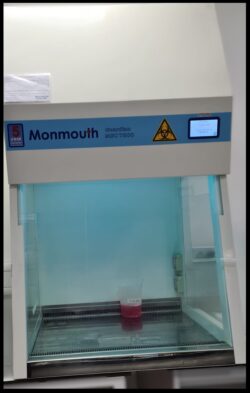
 The Bacterial Hoods (Monmouth - MSGT800 & MSC1200) are state-of-the-art Class II Biological Safety Cabinets (BSC) designed for the secure and sterile handling of hazardous biological materials such as bacterial cultures, viruses, and other microorganisms. They are particularly suited for applications in tissue culture, bacterial cultivation, virology research and other sensitive biological experiments.
They provide a sterile working environment, protecting both the user and the surrounding area through high efficiency particulate air (HEPA) filtered airflow with 99.995% efficiency. They are also equipped with a UV-C light (180-280 nm), used for effective sterilization for workspace disinfection, reducing the risk of cross contamination when handling multiple samples. These hoods are also equipped with a digital control panel for precise airflow monitoring, ensuring consistent operational performance and compliance with safety standards. With an ergonomic, energy-efficient design for long-term, making it an ideal solution for modern laboratories. They also minimizes exposure to hazardous biological agents by containing airborne pathogens, creating a dual barrier of protection for both the user and the samples.
Thess cabinets are a reliable choice for laboratories focused on maintaining high standards of biosafety and contamination control, supporting cutting-edge research and diagnostic processes.
Ultra Syringe Pump (HA Harvard Apparatus PHD)
 The Ultra Syringe Pump (HA Harvard Apparatus PHD) is a high-precision laboratory instrument meticulously designed for the controlled delivery of fluids at low flow rates. It addresses a diverse range of research needs across pharmaceuticals, biology, chemistry, and related fields. With its unparalleled accuracy and reproducibility, the pump has become a cornerstone for sophisticated experimental setups.
One of its standout features is its programmable settings, which allow for customizable flow rates and infusion profiles. This flexibility enables researchers to tailor delivery parameters precisely to meet the requirements of their experiments, ensuring optimal results.
The pump is also highly compatible, supporting a wide range of syringe sizes and fluid volumes. This adaptability makes it suitable for an extensive variety of applications, from intricate microfluidic studies to high-precision pharmacological research.
Ease of use is enhanced by its intuitive touchscreen interface, which provides effortless operation and real-time monitoring of infusion parameters. This feature not only reduces setup time but also improves efficiency in managing complex laboratory workflows.
With superior precision and reproducibility, the pump guarantees consistent and accurate fluid dispensing. This reliability is crucial for delicate procedures, such as cell biology assays, drug delivery experiments, and microfluidics research, where even the smallest inconsistencies can compromise outcomes.
The pump's advanced functionalities further broaden its utility. Features such as continuous or pulsed infusion modes, customizable timing sequences, and options for single or multi-channel dispensing make it highly versatile across various research scenarios.
Manufactured with robust materials and advanced engineering, the pump is built to withstand the demands of intensive laboratory environments. Its durability and reliability make it a trusted instrument for researchers aiming for consistent performance.
This syringe pump finds applications in numerous areas, including controlled drug delivery, enzymatic reactions, flow chemistry, cell stimulation, and nanomaterial synthesis. By offering precise fluid handling and unmatched accuracy, the Ultra Syringe Pump continues to advance experimental capabilities in cutting-edge laboratories worldwide.
Orbital Shaker (Ohaus)

Incubating Mini Shaker (VWR)

Inverted Microscope (CETI Inverso 3000 - {TC-100})

Carbon Dioxide and Oxygen Incubator (GS Biotech 14L)
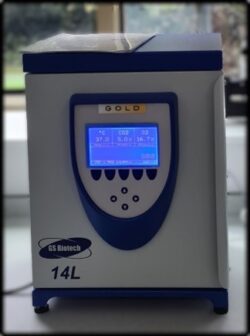
The CO2 and O2 Incubator (GS Biotech 14L) is a cutting-edge laboratory instrument designed to provide the precise environmental control required for cultivating microorganisms and cell cultures. By offering advanced regulation of temperature, humidity, CO2, and O2 levels, the incubator ensures optimal growth conditions, making it indispensable for sensitive and specialized biological experiments.
This incubator is particularly valuable for applications such as tissue engineering, stem cell research, and in vitro fertilization, where maintaining stable and reproducible growth environments is critical. The precise gas regulation allows researchers to create tailored conditions that mimic physiological settings, facilitating studies on cellular development, differentiation, and viability under controlled atmospheric conditions.
Despite its compact size, the GS Biotech 14L is engineered for maximum efficiency, making it an excellent choice for laboratories with limited bench space. Its small footprint does not compromise performance, as the incubator delivers consistent and reliable results across a range of applications, from routine cell culture maintenance to advanced microbiological studies.
A unique feature of this incubator is its ability to regulate variable CO2 and O2 concentrations, allowing researchers to investigate cellular responses to hypoxia, hyperoxia, or other gas conditions. This makes it particularly suitable for exploring processes like tumour microenvironment modelling, metabolic pathway analysis, and disease pathophysiology studies.
Built for durability and ease of use, the incubator incorporates intuitive controls and user-friendly programming to simplify setup and operation. Researchers can precisely monitor and adjust environmental parameters in real time, ensuring consistency throughout the experiment. The device also includes features to minimize contamination risks, safeguarding delicate cultures.
The GS Biotech 14L CO2 and O2 Incubator has become an essential tool in modern laboratories, advancing research in cell biology, microbiology, and biotechnology. Its versatility and reliability make it a cornerstone for experiments requiring meticulous environmental control, enabling scientists to achieve ground-breaking insights and reproducible results.
Oven Incubator (Genlab)
 The Incubator (Genlab) is a versatile laboratory device designed for a range of heating and incubation applications.
Its uniform temperature distribution ensures consistent conditions for incubating samples, promoting accurate experimental outcomes in various biological and chemical processes.
Commonly used in microbiology, biochemistry, and pharmaceutical labs, this incubator supports applications such as bacterial culture growth, enzyme activity assays, and chemical reactions that require controlled heating.
SpectraMax M2 (Molecular Devices)
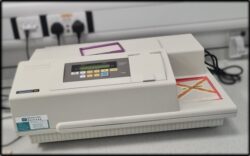 The SpectraMax M2 (Molecular Devices) is a versatile multi-mode microplate reader designed for a wide range of applications in life sciences research, including cell biology, drug discovery, and biochemical assays.
Equipped with advanced optical technology, the SpectraMax M2 can perform various detection modes such as absorbance, fluorescence, and luminescence, making it ideal for analyzing enzyme kinetics, cellular responses, and protein interactions.
Its user-friendly software and high throughput capabilities enable researchers to efficiently conduct assays and generate reliable data, making it an essential tool for laboratories focused on molecular and cellular biology.
Autoclave (Classic Prestige Medical)
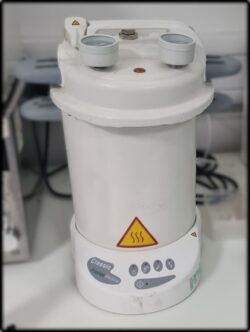 This Classic Autoclave (Prestige Medical) is a reliable sterilization device used in laboratories, medical facilities, and research institutions to ensure the safe and effective sterilization of instruments, glassware, and other materials.
Utilizing steam under pressure, the autoclave achieves high temperatures necessary for killing bacteria, viruses, and spores, making it essential for maintaining sterile conditions in microbiological and clinical environments. Its straightforward operation and robust design ensure consistent performance, making it an invaluable piece of equipment for researchers and healthcare professionals who require strict adherence to safety and hygiene protocols in their work.
Additional Equipments
The bacterial lab is fully equipped with a comprehensive range of advanced instruments to support various cell culture and biological research activities. These instruments are essential for ensuring optimal conditions for cell growth, manipulation, and analysis, providing a reliable and controlled environment for scientific experimentation.
- Incubators (GS Biotech 48L, Grant JB Nova): These incubators maintain precise temperature, humidity, and CO2 & O2 levels to create ideal conditions for cell culture, ensuring consistent growth and viability of cells over extended periods.
- Microwave oven: These oven can safely be used for preparation of media. This method is convenient, reliable, economical, reproducible and saves times.
- Mixers (SciQuip Vortex): These mixers are designed to facilitate gentle or vigorous mixing of cell suspensions and reagents, ensuring uniform distribution and proper mixing of components.
- Microfuge (SciQuip Sigma 1-14): This device (14,800 rpm & RCF of 16,602 x g) is a compact, quiet and powerful microcentrifuge with a 24 place tube capacity. If provides efficient stirring for various laboratory tasks, from mixing reagents to dissolving substances in culture media.
These instruments, available for use in the bacterial lab, offer a comprehensive suite of tools designed to facilitate cutting-edge research in cell biology, and biotechnology. They ensure a controlled, sterile environment for culturing cells and performing essential analytical tasks, supporting a wide range of experimental protocols and research endeavours.