
Particle Measurement Facility
Particle characterisation is the detailed analysis of particles’ physical and chemical properties, including size, shape, distribution, surface area, and charge. This field of study plays a critical role in understanding material behaviour and optimizing performance across industries such as pharmaceuticals, nanotechnology, materials science, and environmental research.
Accurate particle characterisation provides valuable insights into; particle size and distribution (ensuring uniformity and consistency in formulations), shape and morphology (identifying structural characteristics critical to material functionality), and surface properties (analyzing surface charge, energy, and porosity for interactions and reactivity).
Modern particle characterisation leverages cutting-edge technologies such as dynamic light scattering (DLS), nanoparticle tracking analysis (NTA), and laser diffraction. These techniques offer precise measurements, enabling researchers to develop innovative solutions and ensure quality control in manufacturing.
Particle characterisation can be used across industries; pharmaceuticals - controlling drug delivery systems and improving bioavailability, nanotechnology - designing materials with tailored properties for advanced applications, environmental science - monitoring pollutants and optimizing filtration systems and in food and beverages - Ensuring texture, stability, and shelf life of products.
The above image was taken by Damien Batchelor using Zetaview during particle measurement. It captures liposomes in motion, exhibiting Brownian movement as they diffuse through the medium. This technique allows for the visualization and analysis of nanoparticle behaviour, providing valuable insights into their size, distribution, and dynamic properties.
Particle Analysis Equipment
Explore some of our cutting-edge instruments, designed to support advanced research and detailed analysis. By utilizing these advanced techniques, accurate particle analysis enables innovation and improved functionality across diverse applications.
Zetasizer Nano ZSP (Malvern Panalytical)- Advanced Particle and Molecular Characterization

The Zetasizer Nano ZSP is a highly sophisticated instrument designed for the precise measurement of particle size, molecular weight, zeta potential, and microrheology. Manufactured by Malvern Panalytical, it is ideal for research and quality control applications in fields such as nanotechnology, biopharmaceuticals, and materials science.
The Zetasizer Nano ZSP utilizes advanced Dynamic Light Scattering (DLS) technology to measure particle size with exceptional accuracy, even for nanoparticles as small as 0.3 nm. Its superior sensitivity ensures reliable results, making it a benchmark for nanoparticle analysis.
The instrument’s unique Phase Analysis Light Scattering (PALS) technology enables precise measurements of zeta potential, crucial for understanding particle stability and behaviour in colloidal systems. This makes it invaluable for formulations, dispersions, and emulsions.
The Zetasizer Nano ZSP is equipped to handle a wide range of analytical tasks, including: Particle Size Analysis (from small molecules to large complexes), Protein Characterization (measurement of molecular size, aggregation, and interactions), Zeta Potential (analysis of colloidal stability and surface charge properties), Microrheology (probing the viscosity and viscoelastic properties of complex fluids), and High-Resolution Molecular Weight Measurement (the Nano ZSP delivers precise molecular weight measurements using Static Light Scattering (SLS), making it ideal for polymer and biopolymer analysis) and with its intuitive software interface and robust algorithms, the Zetasizer Nano ZSP simplifies complex measurements and ensures consistent, reproducible results. The integrated quality factor alerts provide confidence in data reliability. The key features are: High Sensitivity - (measures particles and molecules from 0.3 nm to 10 μm), Phase Analysis Light Scattering (PALS) (enhanced zeta potential measurement, Wide Concentration Range (suitable for dilute and concentrated samples), Multi-Parameter Analysis (particle size, zeta potential, molecular weight, and microrheology and Temperature Control (measurements from 0°C to 90°C for thermal stability studies).
NanoSight NS300 (Malvern Panalytical) with Nanoparticle Tracking Analysis (NTA)

The NanoSight NS300 is a cutting-edge instrument specifically designed for nanoparticle characterization using Nanoparticle Tracking Analysis (NTA). It provides accurate size, concentration, and fluorescence characterization for nanoparticles in a liquid suspension, making it an indispensable tool for research in nanotechnology, biopharmaceuticals, and environmental sciences.
The NS300 utilizes laser light scattering and a high-sensitivity camera to track individual nanoparticles in real-time. By analyzing the Brownian motion of particles, it determines particle size distribution with high precision, providing visual and quantitative insights into nanoparticle populations.
The NanoSight NS300 supports multiple laser configurations, enabling the analysis of a wide range of particle types, including fluorescently labeled nanoparticles. This versatility is ideal for applications such as: Exosome and Vesicle Analysis (characterizing extracellular vesicles for biomedicine), Vaccine Development (monitoring viral vectors and adjuvant particles), Environmental Studies (assessing nanomaterials in water samples), Nanoparticle Research (studying colloidal systems and nanocarriers), Simultaneous Size and Concentration Measurement (measures nanoparticle size with a range of 10 nm to 1 µm and accurately determines particle concentration. Its ability to quantify both parameters simultaneously makes it a valuable tool for studying particle behavior and consistency, Fluorescence Mode for Specific Label Detection (fluorescence detection mode enables the analysis of labeled particles within a heterogeneous population. This is particularly useful in isolating and characterizing specific subpopulations of nanoparticles, such as protein-tagged exosomes) and User-Friendly Interface and Advanced Data Analysis (NS300 comes with NTA software, which provides an intuitive interface for data acquisition, real-time visualization, and advanced analysis. Its automated focus and syringe pump system enhance ease of use, ensuring repeatability and reproducibility).
The key features are: Particle Size Range - 10 nm to 1 µm for high-resolution sizing, Concentration Measurement - quantifies nanoparticles from 10⁶ to 10⁹ particles per mL, Fluorescence Mode - detects labeled particles in complex samples, Multi-Wavelength Lasers - adapts to various applications and particle types, Real-Time Visualization - provides dynamic insight into particle behavior.
The NanoSight NS300 is used in: Nanomedicine development and drug delivery studies, Protein aggregation and biopharmaceutical stability analysis, Water quality monitoring and environmental nanotoxicology, and Nanomaterial characterization in research and industry.
ZetaView (Particle Metrix) High-Performance Nanoparticle Tracking Analyzer
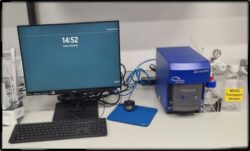
The ZetaView is an advanced particle tracking analyzer designed for the accurate characterization of nanoparticles in liquid suspensions. Using cutting-edge Nanoparticle Tracking Analysis (NTA), the ZetaView provides detailed insights into particle size, zeta potential, and concentration, making it a vital instrument for nanotechnology, biopharmaceuticals, and environmental research.
The ZetaView combines particle tracking with electrophoretic mobility measurements to deliver comprehensive data, including; Size Distribution (tracks and sizes particles ranging from 10 nm to 1 µm), Zeta Potential (provides insights into surface charge for stability analysis), Particle Concentration (measures particle concentrations from 10⁶ to 10⁹ particles per mL. These combined capabilities make the ZetaView a versatile tool for studying complex nanoparticle systems with precision and efficiency.
The ZetaView employs a unique scanning system that captures multiple locations in the sample cell, enhancing data reliability and statistical accuracy. It supports multi-fluorescence detection, enabling the characterization of labeled particles within a heterogeneous mixture, such as fluorescently tagged exosomes or viruses.
The ZetaView is designed for a wide range of applications, including: Exosome and EV Characterization - size, concentration, and surface charge profiling, Biopharmaceuticals - analysis of drug delivery systems, viral vectors, and protein aggregates, Nanomaterials - investigating colloidal stability and behavior of nanostructures, Environmental Science - monitoring nanoparticles in water and other environmental samples, Ease of Use and Intuitive Software - with its user-friendly interface and advanced software, the ZetaView ensures seamless operation and comprehensive data analysis. The system’s automated focusing, temperature control, and robust algorithms simplify measurements while maintaining accuracy and repeatability. The main features are: Size Range (10 nm to 1 µm for versatile nanoparticle tracking), Zeta Potential Measurement (accurate surface charge analysis via electrophoretic mobility), Concentration Measurement (quantifies particle concentration in liquid suspensions), Fluorescence Detection (multi-channel fluorescence analysis for labeled particles), Scanning Capability (enhances data reliability with multiple sample points), and Temperature Control (ensures stable and reproducible measurements).
Archimedes (Malvern) - Advanced Particle Metrology System for Sub-Micron Analysis
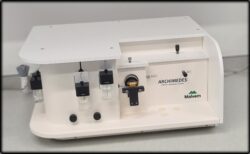
The Archimedes (Malvern) is a cutting-edge particle metrology system designed to measure the size and concentration of particles in the sub-micron to micron range. Using Resonant Mass Measurement (RMM) technology, Archimedes offers unparalleled accuracy in differentiating between particles based on their density, providing essential insights for biopharmaceutical development, nanotechnology, and materials science.
Unlike optical-based techniques, Archimedes detects particles by measuring their buoyant mass as they pass through a microfluidic cantilever. This approach delivers highly accurate particle measurements, even in complex biological or chemical suspensions, enabling the identification of: Protein Aggregates (detection of protein-based impurities in biopharmaceuticals), Silicone Oil Droplets (monitoring contamination in injectable formulations), and Nanoparticles (precise sizing and differentiation based on density and composition). The system is capable of detecting particles as small as 50 nm and as large as 5 µm, offering a comprehensive solution for particle analysis across a wide size range. The Archimedes (Malvern) is a versatile tool, widely used in various fields: Biopharmaceuticals - identifying and quantifying aggregates and contaminants in protein therapeutics, Nanotechnology - characterizing nanoparticle formulations and interactions, Pharmaceuticals - monitoring subvisible particles in injectable formulations, and Environmental Science - studying particle behavior in natural and industrial water samples. The main key features are: Density Differentiation - separates particles based on density (e.g., protein aggregates vs. silicone oil droplets), High Sensitivity - detects particles as small as 50 nm with exceptional precision, Particle Concentration - quantifies particle concentration in real-time, Microfluidic Cantilever Technology ensures minimal sample consumption and high reproducibility, Comprehensive Software - provides intuitive data analysis and visualization for efficient interpretation.
Advantages Over Traditional Methods - The Archimedes system overcomes limitations of optical methods, such as light scattering, by offering - greater sensitivity to subvisible and submicron particles, reduced interference from refractive index variations in complex media and ability to analyze particles in opaque or high-concentration suspensions.