
Spectroscopic Research Facility
Spectroscopy is a powerful analytical technique that examines how materials interact with light across the electromagnetic spectrum. By analyzing these interactions, spectroscopy provides critical insights into the chemical composition, molecular structure, and physical properties of substances, making it an indispensable tool in both research and industry.
Spectroscopy enables scientists to detect and quantify elements, identify compounds, and study molecular behaviour with unparalleled precision. By observing absorption, emission, or scattering of light, it reveals valuable data that supports breakthroughs in fields such as chemistry, biology, physics, and materials science.
Spectroscopy serves as a cornerstone for innovation and quality control in various sectors; pharmaceuticals - identifying active ingredients and ensuring product purity, environmental science - monitoring air and water quality through pollutant analysis, materials science - characterising nanomaterials, polymers, and advanced composites, and food and agriculture - ensuring the safety and authenticity of products.
Modern spectroscopic techniques such as UV-Vis, fluorescence, IR, NMR, and mass spectrometry offer unmatched accuracy and versatility. These tools cater to diverse applications, from routine quality testing to advanced molecular research, driving efficiency and innovation.
The FTIR spectral analysis above was conducted by Joe Fox, during his study on the interaction between Chloroauric acid (HAuCl₄) and Methyl Orange (MO). The coloured vertical lines represent the expected reaction products; 4-Diazobenzenesulfonic acid (4-DBSA)- (dark blue), dimethylammonium ion (orange), and para-benzoquinone (violet, dashed). Black vertical lines indicate peaks common to multiple reaction products.
Core Technologies
Explore some of our cutting-edge instruments, designed to support advanced research and detailed analysis.
IFS 66v/S FTIR Spectrometer (Bruker)
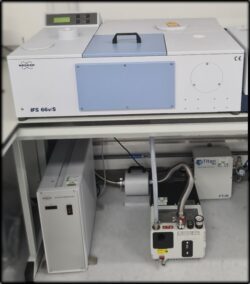 The Bruker IFS 66v/S FTIR Spectrometer is a premium instrument designed for advanced spectroscopy applications, offering unparalleled precision and flexibility. Renowned for its vacuum capabilities and exceptional sensitivity, the IFS 66v/S is an ideal choice for researchers demanding the highest accuracy in infrared spectroscopy.
The IFS 66v/S features a unique vacuum-sealed optical system, effectively eliminating atmospheric interference from water vapor and carbon dioxide. This ensures enhanced sensitivity and reliability, making it perfect for applications requiring ultra-low detection limits, such as trace gas analysis, material characterization, and surface studies.
Designed to accommodate diverse research needs, the IFS 66v/S covers a broad spectral range, extending from the far infrared to the ultraviolet. Its modular architecture supports various beam splitters, sources, and detectors, allowing customization for specialized applications.
IFS Spectrometer equipped with advanced interferometric technology and a high-stability design, the IFS 66v/S delivers exceptional resolution and spectral accuracy. It is capable of resolving fine spectral details, making it suitable for high-end applications in fields like chemical analysis, environmental studies, and materials science.
The spectrometer is powered by Bruker's OPUS software, offering a user-friendly interface for data acquisition, processing, and analysis. Automated functionalities streamline operations, enabling researchers to focus on their studies while ensuring consistent results.
The Bruker IFS 66v/S is utilized across multiple disciplines, including: Analytical Chemistry (precise molecular identification and quantification), Materials Science (structural analysis of polymers, and thin films), Environmental Science (trace gas detection and pollutant monitoring) and Life Sciences (protein and biomolecular studies).
PMA 37: High Precision Polarization Modulation Accessory (Bruker)
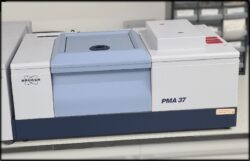 The Bruker PMA 37 is a state-of-the-art polarization modulation accessory designed to enhance infrared spectroscopic capabilities, particularly for studies requiring polarization-dependent measurements. Engineered for use with Bruker FTIR spectrometers, the PMA 37 enables advanced applications such as vibrational circular dichroism (VCD), magneto-optical spectroscopy, and surface studies.
The PMA 37 utilizes precise polarization modulation techniques to achieve superior sensitivity and accuracy in measuring polarized light. This makes it an indispensable tool for researchers studying chiral molecules, magnetic materials, or anisotropic surfaces.
PMA 37 is ideal for; Vibrational Circular Dichroism (VCD) (analyzing chiral molecules in pharmaceuticals and biochemistry), Magneto-Optical Spectroscopy (exploring the magnetic properties of materials), Surface Studies (investigating molecular orientation and thin-film characteristics), and High Sensitivity and Stability.
The PMA 37 is designed to minimize noise and maximize signal clarity, ensuring high reproducibility for even the most demanding experiments. Its robust construction and precision-engineered components deliver long-term stability and performance.
The PMA 37 integrates seamlessly with Bruker’s FTIR spectrometers and OPUS software, providing an intuitive interface for controlling polarization modulation experiments. This compatibility ensures streamlined workflows and reliable data analysis.
Lambda 35 UV/Vis Spectrometer: Precision in Absorption and Transmittance Analysis (Perkin Elmer)
 The PerkinElmer Lambda 35 UV/Vis Spectrometer is a versatile and high-performance instrument designed for a broad range of applications in analytical, environmental, and materials science. Its robust design, advanced features, and user-friendly interface make it an excellent choice for laboratories requiring precise and reproducible results.
The Lambda 35 employs dual-beam optics, ensuring exceptional stability and accuracy in absorbance and transmittance measurements. Its wide wavelength range from 190 nm to 1100 nm makes it suitable for analyzing a diverse array of samples, including liquids, solids, and thin films.
The Lambda 35 is ideal for various fields, including: Pharmaceuticals (quantifying drug formulations and analyzing active pharmaceutical ingredients), Environmental Science (monitoring water quality and pollutant absorption), Material Science (studying optical properties of polymers, coatings, and films) and Food and Beverages (measuring additives, colors, and nutrient levels).
The Lambda 35 integrates with intuitive software that simplifies data acquisition, processing, and reporting. With features like spectral scanning, multi-wavelength analysis, and peak detection, it ensures efficiency and accuracy in routine and advanced applications.
Designed for long-term use, the Lambda 35 combines rugged construction with high-quality optics, ensuring consistent performance in demanding environments. Its low-maintenance operation minimizes downtime and maximizes productivity.
LS55 Fluorescence Spectrometer: High Performance Fluorescence Analysis (Perkin Elmer)

The PerkinElmer LS55 Fluorescence Spectrometer is a versatile and reliable instrument designed for the precise analysis of fluorescence and phosphorescence. Renowned for its sensitivity and flexibility, the LS55 is widely used in life sciences, environmental testing, and materials research to study molecular interactions, quantify analytes, and characterize fluorescent compounds.
The LS55 leverages a high-energy xenon discharge lamp, which provides a broad spectrum of excitation wavelengths for robust fluorescence detection. Its monochromator-based optical system ensures precise wavelength selection, enabling accurate and reproducible measurements across a wide range of applications.
The key features for LS55 fluorescence spectrometer are; Wide Wavelength Range (excitation and emission wavelengths from 200 nm to 800 nm, covering UV and visible spectra), High Sensitivity (exceptional signal-to-noise ratio for detecting low-concentration samples), Time-Resolved Fluorescence (TRF) (analyse phosphorescence and lifetime measurements, Scanning Speed (rapid excitation and emission scans for efficient sample analysis, and Variable Bandwidths (optimize spectral resolution and sensitivity for diverse sample types).
The LS55 is ideal for a wide range of fluorescence and luminescence studies, including: Life Sciences (quantifying DNA, RNA, and proteins; enzyme kinetics; and drug discovery), Environmental Monitoring (detecting pollutants, contaminants, and trace metals), Materials Science (characterizing optical properties of nanomaterials, dyes, and polymers) and Food and Beverage (quality control of additives, vitamins, and colorants).
The LS55 is equipped with FL WinLab Software, providing an intuitive interface for data acquisition and analysis. The main features include: multi-wavelength and kinetics scanning, peak identification and spectral overlays and automated calibration and data reporting.
Built with a rugged design and precise optics, the LS55 delivers consistent performance with minimal maintenance. Its compact footprint makes it suitable for both research laboratories and quality control environments.
Cary Series UV-Vis-NIR Spectrophotometer (Agilent Technologies)

The Agilent Cary Series UV-Vis-NIR Spectrophotometer is a world-class analytical instrument designed to deliver precise and reliable spectroscopic measurements. It offers unmatched accuracy and sensitivity for applications across the ultraviolet (UV), visible (Vis), and near-infrared (NIR) spectral regions, making it a versatile solution for advanced material and chemical analysis.
The Cary Series is renowned for its superior optical design and cutting-edge technology, ensuring accurate measurements with minimal noise. Its broad wavelength range, from 175 nm to 3300 nm, allows for the analysis of diverse samples, from biological compounds to advanced materials.
The main features that redefine precision with UV-Vis-NIR spectrometer; Variable Bandwidth - Customizable settings for optimal resolution and sensitivity, Double Beam Optics - provides unparalleled stability and accuracy by eliminating baseline drift, Temperature Control - advanced accessories for precise temperature-dependent studies, and Scalable Configurations - modular design to accommodate different applications and user needs.
The UV-Vis-NIR spectrophotometer is indispensable in: Pharmaceuticals - analyzing drug formulations, purity, and stability, Materials Science - studying thin films, polymers, and optical coatings, Environmental Science - monitoring pollutants in water, air, and soil and in Life Sciences - quantifying proteins, nucleic acids, and other biomolecules.
Equipped with user-friendly software, the Cary Series simplifies complex workflows with intuitive data acquisition, analysis, and reporting features.
Edinburgh Instruments FLS980-D2D2-st, A3891-1 NIR 300/2 PH1 CO1 TCC2
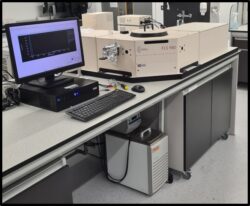 The Edinburgh Instruments FLS980 NIR 300/2 is a state-of-the-art fluorescence spectrometer designed to deliver exceptional performance in steady-state and time-resolved photoluminescence spectroscopy. Tailored for advanced research applications, this system integrates cutting-edge technology with robust versatility to explore complex material properties and molecular interactions.
The FLS980 NIR 300/2 system is equipped to handle a wide spectral range, extending into the near-infrared (NIR) region. Its superior sensitivity and precision make it ideal for characterizing materials and analyzing photophysical properties across a broad spectrum.
The main key features include: PH1 Configuration - enhanced photomultiplier tube (PMT) detectors for high sensitivity and accuracy, CO1 Configuration - high-performance monochromators for superior spectral resolution, TCC2 Temperature-Controlled Chamber - enables precise sample temperature control for temperature-dependent studies and NIR 300/2 Module - optimized for detecting emissions in the near-infrared region, critical for advanced material and biochemical applications.
The FLS980 NIR system is widely used in diverse research areas, including: Nanotechnology - studying quantum dots, nanowires, and other nanoscale systems, Materials Science - investigating semiconductors, polymers, and advanced composites, Life Sciences - analyzing biomolecules, proteins, and cellular interactions and in Energy Research - exploring luminescent materials for solar cells and LEDs.