
Surface Analysis Facility
Surface analysis is a specialized field of material characterisation focused on studying the outermost layers of a material, typically within a few nanometers to micrometers of its surface. This field is crucial for understanding the physical, chemical, and mechanical properties of surfaces, which significantly influence a material's overall performance and interaction with its environment. Whether examining corrosion resistance, adhesion, wettability, or catalytic activity, surface analysis provides critical insights into material behavior under specific conditions.
Various advanced techniques are employed for surface analysis, each catering to specific needs. X-ray Photoelectron Spectroscopy (XPS) is widely used to analyze the elemental composition and chemical states of a material's surface. It is particularly valuable in studying coatings, thin films, and surface contaminants. Another key technique, Atomic Force Microscopy (AFM), enables the high-resolution imaging of surface topography at the nanoscale, providing information about surface roughness, texture, and mechanical properties. Scanning Electron Microscopy (SEM), often coupled with Energy-Dispersive X-ray Spectroscopy (EDX), offers detailed imaging alongside elemental analysis, making it a powerful tool for surface investigations.
Surface analysis has a broad range of applications across industries. In materials science, it aids in developing advanced composites, coatings, and nanomaterials with tailored properties. The pharmaceutical industry uses surface analysis to study drug delivery systems and ensure the stability of formulations. In electronics, it is critical for characterizing semiconductors and microchips, ensuring their efficiency and reliability. Environmental science also benefits from surface analysis by examining pollutant interactions with surfaces or understanding soil and mineral properties.
By enabling a deeper understanding of surface phenomena, surface analysis plays a pivotal role in innovation, quality control, and the development of next-generation materials and technologies.
Laboratory Resources
Explore some of our cutting-edge instruments, designed to support advanced research and detailed analysis. By utilizing these advanced techniques, accurate surface analysis enables innovation and improved functionality across diverse applications.
Langmuir Trough (KSV NIMA): study and characterizing molecular monolayers

The Langmuir Trough (KSV NIMA) is a precision instrument designed for the detailed study of molecular monolayers and their behaviour at air-liquid interfaces. Widely used in materials science, biophysics, and nanotechnology, this system enables researchers to manipulate and characterize thin films with exceptional control and accuracy.
The innovative design of the Langmuir Trough, allows for the precise control of surface pressure and molecular packing at the air-liquid interface. It is essential for creating and analyzing monolayers, facilitating research in areas such as: Lipid Membrane Studies (investigating biological membranes and surfactants), Nanomaterials Development (studying the self-assembly of nanoparticles and polymers) and Coating and Film Applications (designing functional thin films and coatings).
The key features include: Modular Trough Design - available in various sizes and materials to accommodate diverse experimental requirements, High Sensitivity Surface Pressure Sensors - accurate measurement of isotherms for monolayer studies, Automated Barrier Control - ensures precise compression and expansion of monolayers, Optional Accessories - includes Temperature Control - enables studies of monolayer behaviour under varying thermal conditions and dipping mechanisms for Langmuir-Blodgett (LB) film deposition systems, allowing researchers to transfer monolayers onto solid substrates with nanoscale precision. This capability is critical for fabricating multi-layer films used in sensors, electronics, and optoelectronic devices.
The Langmuir Trough have multiple applications across disciplines like: in Material Science (understanding molecular interactions and film stability), in Biophysics (studying lipid monolayers and their role in cellular membranes), in Nanotechnology (developing advanced nanocomposites and coatings) and in Environmental Science (investigating surfactants and their impact on aquatic systems).
DataPhysics Instruments TP50 - OCA 25 From DataPhysics - Optical Contact Angle Measuring System

The DataPhysics TP50 Optical Contact Angle Measuring System is a highly accurate and versatile instrument designed for surface analysis and wetting behaviour studies. By measuring contact angles, surface free energy, and interfacial tensions, the TP50 provides essential data for material characterization in research and industrial applications.
The TP50 utilizes high-resolution imaging and advanced analysis software to accurately determine the contact angles of liquids on solid surfaces. This enables researchers to assess surface wettability, adhesion properties, and coating performance with exceptional precision.
The main features of TP50 are: High-Resolution Optics provides clear imaging for precise angle determination, Wide Measurement Range can accommodates a variety of sample sizes and liquids, Dynamic and Static Angles measures advancing, receding, and equilibrium angles, Surface Free Energy Analysis calculates surface energy based on contact angle data and User-Friendly Software facilitates data acquisition, processing, and reporting.
The TP50 is suitable for a wide range of applications, including: Coating and Material Science - evaluating the hydrophobicity and adhesion of coatings, Pharmaceuticals and Biotechnology - studying drug delivery systems and biomaterial surfaces, Packaging and Printing optimizing surface treatments for inks and adhesives and Nanotechnology - investigating wetting properties of nanostructures and films.
The TP50 is compatible with various liquid types and surface conditions, making it an adaptable tool for diverse experimental needs. Its modular design supports additional accessories such as temperature-controlled stages and environmental chambers for specialized studies.
With its advanced software, the TP50 offers robust data analysis capabilities, including curve fitting, baseline correction, and graphical reporting. This ensures high-quality results that meet the rigorous demands of scientific and industrial research.
MCR 302 Modular Compact Rheometer (Anton Paar): Precision Rheology for a Wide Range of Samples

The Anton Paar MCR 302 Modular Compact Rheometer is a versatile and advanced instrument designed to measure the flow behaviour and viscoelastic properties of materials. From low-viscosity liquids to soft solids like gels, the MCR 302 provides unparalleled precision and adaptability, making it an indispensable tool in rheological analysis.
The MCR 302 supports rotational and oscillatory testing modes, enabling researchers to analyze complex material behaviours. With interchangeable measuring geometries such as concentric cylinders, parallel plates, and cone-and-plate configurations, it accommodates a wide range of sample types and experimental requirements.
MCR 302 cutting-edge features for superior performance are: High-Precision Air Bearing - ensures stability and sensitivity during measurements, Dynamic EC Motor - provides precise control for consistent and repeatable results, TruRate Sample-Adaptive Motor Controller - automatically adjusts to sample conditions for optimal performance, TruStrain Real-Time Position Control - guarantees precise strain application, even in dynamic tests, TruGap Automatic Gap Control System - enables precise and repeatable gap settings for consistent results, Integrated Normal Force Sensor - measures normal forces with exceptional accuracy and High-Resolution Optical Encoder - delivers detailed and reliable data across a torque range of 0.5 nN·m in oscillator and 1.0 nN·m in rotation to 230 nN·m.
The MCR 302 features the T-Ready function, allowing precise temperature-controlled measurements between -40°C to 200°C, ensuring accuracy in temperature-sensitive materials. Coupled with the innovative RheoCompass software, users can design, execute, and analyze complex experiments with ease, ensuring streamlined workflows and comprehensive data analysis.
The MCR 302 excels in determining rheological properties, including viscosity, shear stress, shear modulus, and more. It is ideal for: Polymers and Plastics - evaluating melt flow and elasticity, Food and Beverages - analyzing texture and stability, Cosmetics and Pharmaceuticals - measuring the viscoelastic properties of creams and gels and Materials Science: - investigating composite materials and suspensions.
Q-Sense E4 Quartz Crystal Microbalance with Dissipation (QCM-D)

Quartz Crystal Microbalance with Dissipation Monitoring (QCM-D) comprising of QE401 Electronics Unit, QCP401 Chamber Platform, QFM401 FLow Module, Ismatec Pump IPC with QSoft401 software. QCM-D is a highly sensitive, real-time analytical technique used to study surface interactions and material properties at the nanoscale. It works by oscillating a piezoelectric quartz crystal at its resonance frequency and tracking changes in frequency (Δf) due to mass uptake or loss on the sensor surface, with sensitivity as fine as ~0.5 ng/cm² (5 pg/mm²). Simultaneously, it measures energy dissipation (ΔD), offering insights into the viscoelastic nature of adsorbed films—helping determine whether a layer is rigid, soft, or viscoelastic.
At the core of our QCM-D capability is the E4 Analysis Head by Biolin Scientific. This state-of-the-art instrument supports four parallel measurement channels for high-throughput analysis and utilizes advanced ring-down detection technology, capturing up to 100 data points per second. Its Smart Tuning functionality dynamically optimizes signal quality, making it effective for monitoring both rapid and subtle processes, from sub-monolayer adsorption to dynamic interface changes in liquids and soft matter systems.
The Analyzer is equipped with precise temperature and flow control and supports a wide array of modular upgrades, including electrochemical cells, optical microscopy, ellipsometry, and high-pressure or high-temperature configurations. Its extensive library of sensor coatings (over 100 types) and customizable modules enable versatile application across various scientific fields, such as biomaterials, polymers, nanotechnology, electrochemistry, surface coatings, and food science.
At our university, the QSense E4 is a cornerstone instrument for interdisciplinary research. It enables detailed investigations into molecular adsorption, thin film formation, cell adhesion, polymer swelling or collapse, and the performance or degradation of surface coatings. With its unmatched sensitivity, real-time monitoring, and flexible experimental design, it continues to support groundbreaking research in both fundamental science and applied innovation.
M-2000 FLS 860 Spectroscopic Ellipsometer (J.A. Woollam): Thin Film Characterisation

The M-2000 Spectroscopic Ellipsometer is a high-precision optical instrument designed for comprehensive thin-film characterization. With its state-of-the-art technology, the M-2000 provides detailed insights into film thickness, optical constants, and material properties across a broad spectrum range.
The M-2000 features a wide spectral range, covering 245 nm to 1100 nm. This capability allows the instrument to analyze materials with diverse optical properties, making it suitable for a wide array of applications in research and development.
With its rotating compensator design, the M-2000 enables rapid data collection, providing complete spectra in a fraction of a second. This feature is ideal for both static and dynamic measurements, offering unmatched efficiency and precision.
The M-2000 is used in various industries, including: Semiconductors - characterizing thin films, multilayers, and coating stacks, Photovoltaics - analyzing optical properties of solar cell materials, Nanotechnology - investigating nanoscale films and structures and in Biotechnology - studying biofilms and biological coatings.
The system integrates with CompleteEASE software, offering intuitive and flexible tools for data modeling and analysis. Users can fit measured data to sophisticated models, enabling precise determination of thickness, refractive index, and extinction coefficient. The key features of the ellipsometer are: Broad Spectral Coverage (UV-Visible-NIR range for versatile material analysis), Rotating Compensator Technology (ensures accurate polarization measurements with high-speed operation), Dynamic Measurements (real-time analysis for process monitoring and material changes), Flexible Sample Compatibility (supports a wide range of substrates and thin-film types).
ESCALAB 250XPS (Thermo): Advanced Surface Analysis for Precision Research
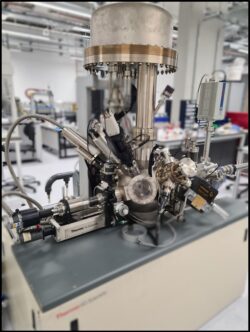 The Thermo ESCALAB 250 XPS (X-ray Photoelectron Spectrometer) is a cutting-edge analytical instrument designed to provide detailed surface characterization with exceptional accuracy. This state-of-the-art system is used for studying the elemental composition, chemical states, and electronic structures of material surfaces, making it an indispensable tool for advanced research and quality control.
Equipped with advanced XPS technology, the ESCALAB 250 offers; High-Resolution Spectroscopy (enables precise identification of surface elements and chemical states), Depth Profiling (analyzes layered materials to reveal compositional changes beneath the surface), Mapping and Imaging (provides spatial distribution of elements across the sample surface) and Versatile Sample Handling (supports various material types, from thin films to bulk solids).
The ESCALAB 250 is pivotal in fields such as: Materials Science - Investigating coatings, thin films, and nanostructures, Electronics - Characterizing semiconductors and device interfaces, Energy Research - Analyzing catalysts, battery components, and fuel cells, and Environmental Science - Monitoring surface contamination and corrosion.
The system integrates user-friendly software with automated workflows, enabling researchers to perform complex analyses with ease. Its superior sensitivity and robust design ensure reliable, reproducible results in demanding laboratory environments.