
Hyperspectral BioImaging Facility
See what we've been doing recently:

Spontaneous Raman Spectroscopy and Stimulated Raman
Scattering for Single Cell Analysis of Colorectal Cancer
(click image for large, high resolution image)

SRS Imaging of Kidney Organoids, Cells and
delivery of a Model Drug – PoC Work
(click image for large, high resolution image)

Stimulated Raman Scattering and Second Harmonic
Generation Multimodal characterisation of decellularized
porcine tendon
(click image for large, high resolution image)
EPSRC funded Strategic Equipment: EP/Y01488X/1
The ability to visualise molecules, cells, tissues and other materials using optical microscopy is often limited by the researcher's ability to successfully label different components with a suitable dye, which can be inefficient and expensive, and also requires the researcher to know what they are looking for in advance of the experiment.
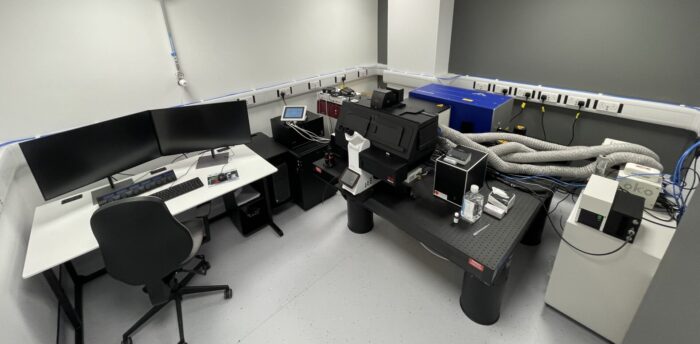
The Stellaris 8 CRS Microscope will enable researchers to map how different molecular species are distributed in their samples by observing their unique molecular fingerprints. This type of imaging allows imaging without requiring the 'labelling' or 'tagging' of components with dye molecules, providing real-time, high-resolution imaging of complex systems.
The Stellaris 8 microscope will enable multimodal imaging and measurements across various biophysical research areas in a manner that is not currently possible, enhancing existing research and leading to new research and collaborations across multiple institutions.
About the microscope system:
Stellaris 8 FALCON platform: (click here for further info)
- White Light Laser (440-790nm) - pulsed
- 405nm Laser
- 2x high performance detectors
- 2x time resolved detectors for TauSense (click here for further info)
- Resonant scanner for video rate acquisition
- Standard confocal modalities: Z-stack, mosaics, time etc
- Lightning mode to 'stretch' the optical limit
- 2 photon and SHG fluorescence modes
Coherent Raman Scattering: (click here for further info)
- Fixed laser beam @ 1032nm
- Tunable laser beam @720-980nm
- SRS detector
- Epi-CARS detector
About the facility team:
Professor Stephen Evans - Head of School of Physics and Astronomy
Dr Julia Gala de Pablo - Lecturer in Biophysical Approaches for Healthcare
Dr Benjamin Johnson - Experimental Officer & HYBIFA Manager
How to apply for access:
Access will be free for an initial period, for proof of concept data etc. Further access may be chargeable. We will discuss this further with you following your application.
Please complete the access request form, by clicking here.
If you wish to submit additional information this can be added by replying to all, upon receipt of the confirmation email. We aim to respond, to all requests within 72 hours.